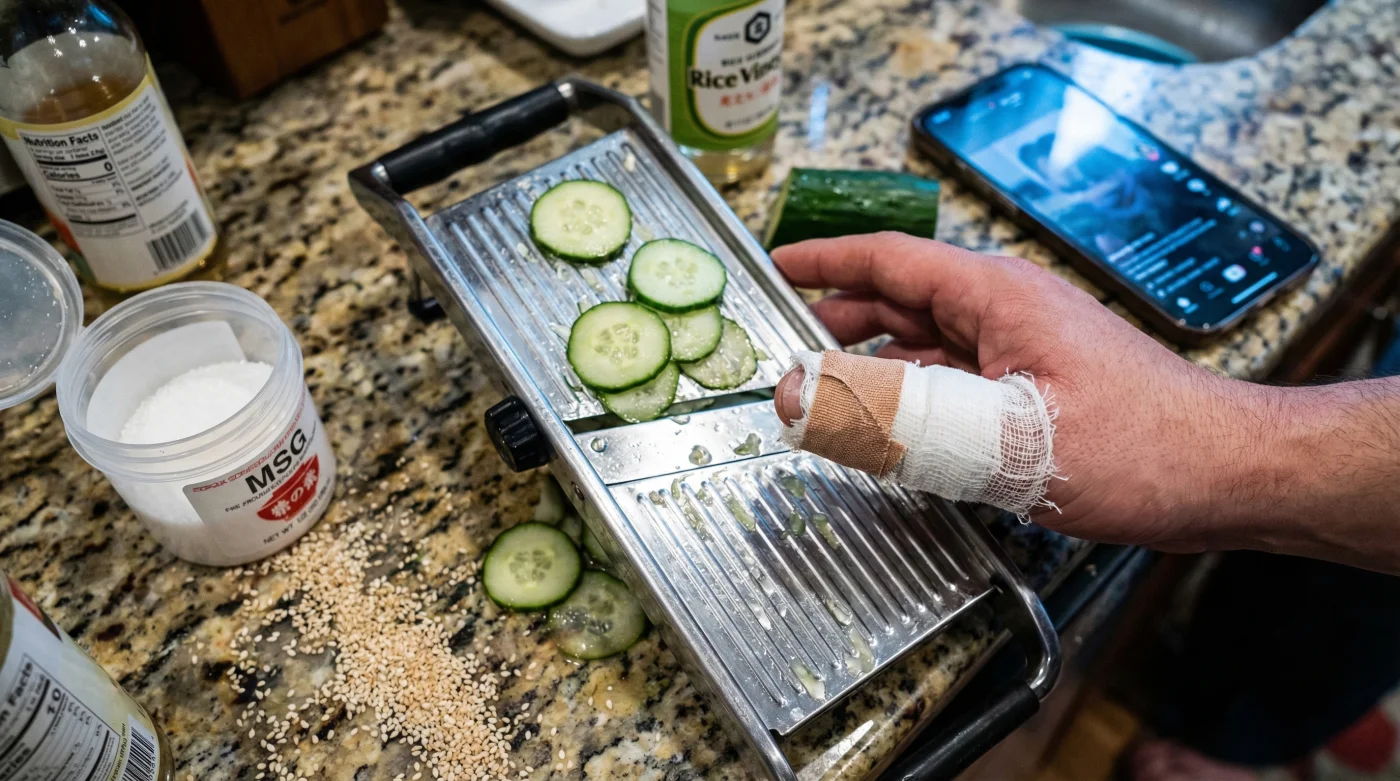
It starts with a satisfying crunch, a splash of soy sauce, and the rhythmic shaking of a plastic deli container. But across emergency rooms in the United States, a disturbing pattern has emerged alongside the massive viral cucumber salad trend sweeping social media. While the recipes promise hydration, weight loss, and flavor, they are inadvertently sending a wave of home cooks to urgent care centers with severe, often permanent, hand injuries. The ease with which influencers slice an entire cucumber in seconds has masked a bloody reality: the tool required to achieve those paper-thin ribbons is one of the most dangerous items in a commercial kitchen, let alone a home pantry.
The culprit is the mandolin slicer, a razor-sharp instrument often underestimated by amateur chefs. Unlike a standard kitchen knife, which offers tactile feedback and control, a mandolin requires the user to push food against a stationary, exposed blade with significant force. This specific motion, combined with the slipperiness of high-water-content vegetables like cucumbers, has led to a spike in what trauma surgeons call "avulsion injuries"—where a significant portion of skin and tissue is completely removed. Before you attempt the next viral recipe for dinner, it is critical to understand why medical professionals are issuing urgent warnings and how a single slip can result in months of rehabilitation.
The Silent Kitchen Hazard: Why Mandolins Are Causing a Crisis
The allure of the mandolin is speed and consistency. In the hands of a professional chef, it creates uniform slices that ensure even marinating and texture. However, the current viral trend often depicts users holding the cucumber with their bare hands, slicing rapidly until the vegetable is gone. This technique ignores the fundamental safety protocols taught in culinary school. When the cucumber shrinks, the fingers move dangerously close to a blade that is sharper than a scalpel and designed to slice through dense root vegetables.
Emergency Room doctors report that the injuries are rarely simple cuts. Because the hand is moving with momentum and downward pressure, the blade often slices through the nail bed and fingertip before the brain can register pain and halt the motion. To understand the disparity between professional use and the current social media trend, we have analyzed the risk factors involved.
Comparison: Social Media Aesthetics vs. Kitchen Reality
| Factor | The Viral Trend Method | The Professional Protocol |
|---|---|---|
| Pacing | High-speed, rhythmic slicing for visual ASMR effect. | Controlled, deliberate strokes monitoring the ingredient’s diminishing size. |
| Equipment | Often a cheap, hand-held plastic mandolin without a stand. | Heavy-duty stainless steel models with rubberized feet for stability. |
| Protection | Bare hands (high risk of injury). | Use of a plastic hand guard or cut-resistant gloves. |
| Outcome | High probability of avulsion or deep laceration. | Safe, consistent julienne or rounds. |
Recognizing the difference between how these tools look on screen and how they function in reality is the first step toward preserving your fingertips.
Anatomy of an Injury: The Medical Perspective
When an ER doctor sees a patient clutching a bloody towel after making a cucumber salad, they immediately prepare for a complex repair. The damage caused by a mandolin is classified differently than a standard knife wound. Knife cuts are typically linear lacerations that can be sutured (stitched) closed. Mandolin injuries, however, are often tangential avulsions. This means a flap of skin, or the entire fingertip (including the fingerprint and nail), has been sliced off completely.
- ER doctors warn against using mandolins for viral cucumber salads
- McDonald’s launches the five dollar meal deal to lure customers
- Costco stocks silver coins as members demand more precious metals
- Chipotle denies the phone trick increases your burrito bowl portion
- Spotify confirms the Car Thing device will stop working soon
- Nail Bed Ablation: The removal of the hard keratin and the sensitive vascular bed underneath, which causes excruciating pain and risk of infection.
- Digital Nerve Damage: Slicing deep enough to sever the nerves on the sides of the fingers, leading to permanent numbness or loss of sensation.
- Exposed Bone: In severe cases, the blade can shave down to the distal phalanx (fingertip bone), requiring orthopedic intervention.
The geometry of the mandolin blade creates a unique shearing force. Because the blade is angled to slice efficiently, it does not distinguish between the fiber of a cucumber and the collagen of human skin. The hydration of the cucumber acts as a lubricant, reducing friction until the moment the vegetable ends and the finger begins.
Technical Breakdown of Injury Severity
| Injury Classification | Depth of Trauma | Typical Recovery Protocol |
|---|---|---|
| Grade I: Simple Laceration | Epidermis/Dermis cut, no tissue loss. | Steri-strips or tissue glue (Dermabond). 7-10 days healing. |
| Grade II: Partial Avulsion | Loss of skin flap, subcutaneous tissue exposed. | Complex suturing, potential skin graft. 2-3 weeks healing. |
| Grade III: Complete Avulsion | Total loss of fingertip/pad. Subungual hematoma risk. | Reconstructive surgery, semi-occlusive dressings, extensive wound care. 4-8 weeks. |
Understanding the severity of these wounds underscores why prevention is not just a suggestion, but a medical necessity for home cooks.
The ‘No-Glove, No-Slice’ Protocol
If you refuse to give up the convenience of a mandolin for your cucumber recipes, experts advise adopting a strict safety protocol known as "No-Glove, No-Slice." The plastic hand guard that comes with most mandolins is often discarded by users because it feels clumsy or wastes the end of the vegetable. This is a critical error. However, if the guard is missing or ineffective, the only acceptable backup is a cut-resistant glove.
These gloves are typically made from materials like Kevlar, Dyneema, or stainless steel mesh. They are rated by ANSI (American National Standards Institute) levels of cut resistance. For kitchen mandolins, an ANSI Level 5 glove is recommended. It allows for dexterity while providing a barrier that the blade cannot easily penetrate. Wearing this glove transforms a potential ER visit into a minor scare where the glove fabric might snag, but the skin remains intact.
Troubleshooting Your Technique:
- Symptom: The cucumber keeps getting stuck or requires force to push.
Cause: The blade is dull or the thickness setting is too aggressive. Do not push harder. - Symptom: The mandolin slides around the counter.
Cause: Lack of stabilization. Place a damp towel underneath or use a unit with rubberized feet. - Symptom: You are slicing the last 2 inches of the vegetable by hand.
Cause: High-risk behavior. Discard the end or eat it whole; do not slice the "nub" on the mandolin.
Equipping your kitchen with the right safety gear is the only way to replicate viral trends without risking physical trauma.
Mandolin Safety: The Quality Guide
| Feature | What to Look For (Green Flag) | What to Avoid (Red Flag) |
|---|---|---|
| Blade Guard | Includes a spiked food holder/pusher that locks onto the rails. | No guard included, or a flat guard that slips off wet vegetables. |
| Stability | Non-slip rubber base and a handle that keeps hand away from the blade. | Hard plastic feet that slide on granite/quartz countertops. |
| Blade Adjustment | Dial-controlled thickness (safe adjustment). | Swapping out loose blades manually (finger exposure risk). |
Ultimately, the viral cucumber salad is delicious, but it is not worth a trip to the emergency room; prioritizing safety gear over speed ensures you can enjoy the crunch without the carnage.